Over the last 20 years we have seen major advancements in permeable pavements. The first permeable paver was introduced here in North America in 1989.
The system was introduced by UNI-GROUP U.S.A. which introduced the UNI Eco-Stone.® Since the introduction of the Eco-Stone the UNI-GROUP U.S.A. has introduced three more pavers to their family. They include Uni Ecoloc, Eco-Optiloc, and Eco-Priora for details on the different pavers in the UNI Family click here.
In New England there are two UNI manufacturers. They are Ideal Concrete Block and Unilock. Ideal is a local manufacturer with a plant in Massachusetts. Unilock on the other hand is a manufacturer with plants in the eastern United States and in Canada. Unilock was the first company in North America to manufacture concrete pavers. Unilock alone has six different styles of permeable interlocking concrete pavers (PICP) including the brand new Town Hall pictured below that replicates an old clay brick without compromising the strength of a manufactured concrete product. Since the Eco-Stone is more "commercial" looking many manufacturers have come out with new pavers many of which can be installed as either permeable or traditional interlocking system.
This helps to bridge the gap between residential and commercial applications. This is a really neat advancement in the industry.
One company that is leading the way into the new permeable paver look is Techo-Bloc. Techo-Bloc is educating contractors on the installing permeable pavements in conjunction with rain water harvesting systems. To see the educational video's check out Techo-Bloc's own Youtube channel. Aquascape produces components for these rainwater harvesting systems as well as supplies for building ponds and water-features.
The topic written about in this post is the effects of runoff water to the water supply and the “Eco-Friendly” permeable pavements. The article may be too technical for some but may be engaging for the engineering type.
The main focus of the article is to see how permeable pavements are an effective way to keep the rain water controlled. At this site they used permeable pavers, permeable asphalt, and permeable concrete. The expert contacted was Amy Rowe of the US EPA. She has a PHD and is monitoring a site in New Jersey which they are using to see the benefits. The site that is used is the EPA employee parking lot at the office in Edison which is shown below. To see the EPA's information click here.
The original article where the idea came from for this post is called “US EPA Tests Permeable Pavements” in the Interlocking Concrete Pavement Magazine which is a publication of the Interlocking Concrete Pavement Institute. At the site they will be monitoring runoff flows. Changes in the water table level will be measured to see the positive impacts of groundwater recharge. Amy said that these results will be long in coming because the water table under this site is a long way down.
The article stated that many cities in the U.S. are serviced by combined sanitary and storm sewer systems. The sewage treatment plants can’t always process the combined flows therefore raw sewage is discharged into rivers and lakes damaging water supplies and ruining recreational areas.
The Permeable Pavements will decrease the amount of runoff. A publication from paver manufacture, Techo-Bloc, says that the EPA estimates that 70% of pollutants in surface water come from storm water. 
The results of this is what the EPA is measuring along with the water quality data such as “total suspended solids, pathogens, nutrients (nitrogen and phosphorous forms), metals (Cadmium, chromium, copper, zinc, lead) as well as organic carbons (From oils and grease).” The article claims that this “project is the most comprehensive and significant due to its unique design and comprehensive approach to long-term data collection and analysis. As the years go by we look forward to seeing the results from this project and many more.
Many of us have either seen clips like this on TV, the internet, or have witnessed it in real life. It is the sights and sounds of man-kinds' advancements in the world of technology and innovation. Sending a man into space is not only an incredible feat, but it also brings a new sense of respect for nature and it's beauty.
This mental illustration became clear once again to me recently as I thought back on my latest experience with retaining wall products. Yesterday, I had the privilage to attend a trade show in Boston called New England Grows. While I was there, I stopped by the booth of a company that I would consider to be one of the most highly respected, established, and innovative in the industry, Unilock. As many of you know, a while back I wrote an article discussing 'The Newest Rage with Retaining Wall Block'. I briefly discussed how retaining wall manufacturers are bridging the gaps between natural stone and man-made products. Here is the next one!...
I am thrilled to introduce to our readers one of the absolutely stunning innovations unveiled recently to our industry... 'Rivercrest' Stone! 
All that I could say was 'WOW'!! Available this spring, this fantastic block is available in two colors, two thicknesses, and is double sided for retaining and sitting walls alike.
This is going to be an absolute revolution, folks!! We are seriously moving into a new age of retaining wall blocks, and Unilock is leading the way! In my opinion, Unilock is the Apollo 11 in wet-cast retaining walls. Meeting and exceeding some of highest specs known to the industry, Unilock continues to blaze the trail into new territories in the Green Industry.
Related Articles:
4 Things to consider when planning a retaining wall
How to Choose a GOOD Contractor
The concrete industry calls it Efflorescence. It is a natural byproduct of the concrete manufacturing process.
Efflorescence:
ef-flo-res-cence (ef∋ le res∋ens), 1. a change on the surface to a powdery substance upon exposure to air, as a crystalline substance through loss of water. 2. to become incrusted or covered with crystals of salt or the like through evaporation or chemical change.
Efflorescence is the stubborn problem that has caused confusion and trouble for the masonry and concrete industry since the first time it appeared thousands of years ago on ancient masonry walls. Efflorescence is normally the white, powdery scum that can appear on masonry walls after construction but can also be brown green or yellow, depending on the type of salts. Nobody likes it, nobody wants it on their walls or pavers, but occasionally this persistent problem appears.
Great deals of time, money and effort have been spent trying to solve the difficulties efflorescence generates. Many test programs have been developed and numerous attempts have been made to eliminate the efflorescence problem. Unfortunately, nothing has proven 100% effective against this very stubborn problem. However, even though no surefire cure has been discovered, a great deal has been learned about how efflorescence works and how to prevent it, and if preventive measures are inadequate, how to remove the efflorescence if it does appear.
What is Efflorescence?
We know that efflorescence is a fine, white, powdery deposit of water-soluble salts left on the surface of masonry as the water evaporates. These efflorescent salt deposits tend to appear at the worst times, usually about a month after the project is constructed, and sometimes as long as a year after completion.
Required Conditions:
Efflorescence is not a simple subject. Three conditions must exist before efflorescence will occur.
- First: There must be water-soluble salts present somewhere in the wall.
- Second: There must be sufficient moisture in the wall to render the salts into a soluble solution.
- Third: There must be a path for the soluble salts to migrate through to the surface where the moisture can evaporate, thus depositing the salts which then crystallize and cause efflorescence.
All three conditions must exist. If any one of these conditions is not present, then efflorescence cannot occur.
This article is courtesy of masonryinstitute.org.
Related Articles:
The top 7 Problems and Solutions of Interlocking Concrete Pavers
How to Choose a GOOD Contractor

The benefits of paver driveways go beyond being aesthetically pleasing to the eye. Paver driveways when installed correctly outlast both asphalt driveways and poured concrete driveways. Asphalt and concrete will crack and become an eyesore and potentially a hazard. For correct paver driveway installation click here.

Another option which is "Eco-Friendly" is permeable pavers which allow the water to pass down through the surface of the pavement keeping runoff water to a minimum. Runoff from driveways and parking lots pollute the local streams, rivers, and lakes.
With pavers there are many more options for the consumer. Choices include color, texture, size, and shape. Asphalt and concrete are fairly limited in their choices especially when compared to the plethura of choices that pavers offer.
When choosing a contractor for your job there are also a lot of choices. Making the correct choice when picking your contractor is key in any project. A new driveway is a substantial investment, so why not do your homework and get a qualified company so that the driveway will function as needed and look good too? Pavers may also settle as blacktop and concrete do but to repair a paver driveway, the impact to the consumers wallet and the look of the driveway will be better once the pavers are repaired than either concrete or asphalt.
A bad contractor can leave a bad taste in anybody's mouth but this fall I had the opportunity to fix a paver driveway installed by a contractor who did not install according to industry standards. The homeowners were very dissappointed and were spending more money to get the driveway fixed. The pictures hardly do the flaws on this project justice. Pictures can never seem to gather the true beauty or the mess of a project.
Related Articles:
The Top 7 Problems and Solutions of Interlocking Concrete Pavers
How to Prepare your Concrete Pavers for Winter
How to Choose a Good Contractor
Techo-Bloc is one of the most well recognized names in the hardscape industry. With their state of the art manufacturing, first class service, and transferable lifetime warranty on most of their products, they are poised once again this year to launch forward. Hot of the presses comes their newest, latest and greatest materials. Highlighted below are a number of their new models.
60" Rocka Step

For the past couple of years, the 48" Rocka has been one of the finest monolithic concrete steps available. Now once again, Techo-Bloc has stepped to the plate and made this great product available to you as a 60" piece.
York Step

A beautiful addition to their step collection, York Steps come to us as a 60" piece. A powerful spinoff of the split-faced natural stone, York captures the beauty and elegance that natural stone affords.
Maya Steps-
Maya Steps continue to bridge the gap between natural stone and man-made replicas. These beauties offer a casual option to those of you looking more for the slab stone appearance.
York Counter Caps
A brand new line of products last year, the York Caps were a true hit with contractors and homeowners alike. With their semi-smooth tops and chisled faces, the York Caps brought a simple and yet elegant crown for retaining walls and steps. Now, they are available to you as a 24"x36" Counter Cap. (actual counter cap not shown).
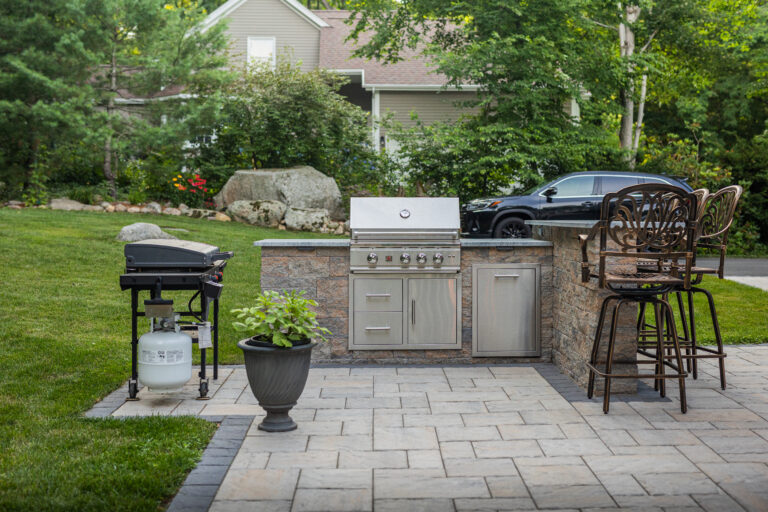
Do I have to have a bar if I install an outdoor kitchen? This question comes to me often as I am designing a patio for a homeowner. The short answer is 'no'. As we design outdoor kitchens, we begin by looking at the homeowner's lifestyle. That in of itself may determine whether a bar or serving counter is applicable to the situation. If the grill is a place of solitude after a long day's work, or just another appliance to get a meal prepared, then a bar probably is not necessary.
In the event that you are like many other folks out there, the grill is a gathering place. A place where the family assembles after a day of being apart, or where drinks are passed to friends as they gather together to observe their steak or kabob being grilled to perfection. If this sounds like you, then a bar may be something you want to consider.
The beauty of an outdoor bar is how versatile it can be...
Outdoor bars can be as intimate as a space for two to sit and quietly catch up
,
or it can be large enough to accomodate a large group of friends taking a break

They can be incorporated into a monolithic counter top
Or they can be a seperate entity
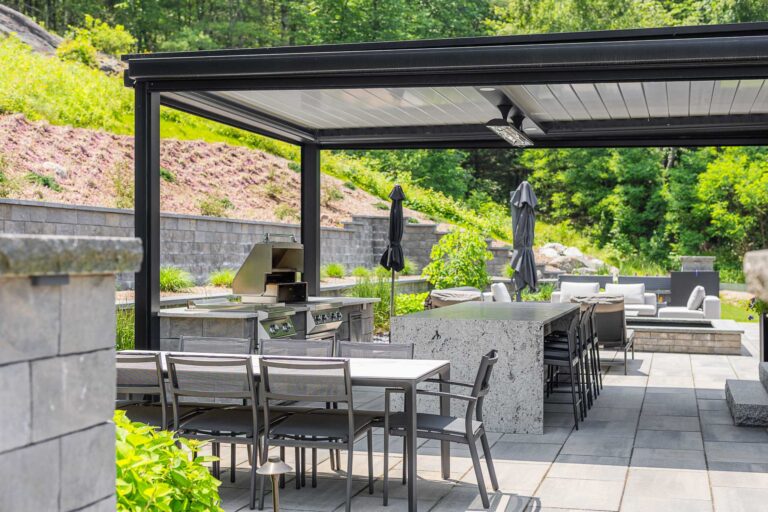
An outdoor bar like an outdoor kitchen can easily have a shade structure built over it,
or it can be out where it's users can absorb some sun rays.
Outdoor bars are highly functional and can be used as a serving counter for larger parties
As you can see, if you can imagine it, it probably can be constructed to fit your needs. Let your imagination run wild... How would you use an outdoor bar?
Parting Shot
Related Articles:
How do I plan my Outdoor Kitchen
How much does a Built in Grill Cost
What is Outdoor Living

Does the title of this article have you a bit interested? How can you have a rage in retaining wall block?
Well, if you think back 15 years or so, you may recall that there weren't too many interlocking blocks available. We had the basic hollow core blocks such as the 'Allen Block'. These units have stood the tests of time, and are still structural 'giants' in our industry. Trust me, they were a HUGE step up from the timber or railroad tie walls that we were used to seeing/constructing.
A
dvance approximately another 5 years, and we were introduced to the tumbled retaining/garden wall blocks such as 'Brussels' from Unilock, 'Mini-Creta' and 'Quarry Stone' from Techo-Bloc. While still being very structurally sound, these block introduced the world to a whole new look of retaining walls. Now we had options!
Advance to Present. So what's new? The blocks mentioned above still pretty much rule the market. However, there is a new manufacturing process that is rearing it's head. It's called the wet-cast block. These stones while not quite as dense as some of their predescessors, they are the new-kid-on-the-block. They pack an incredible 'WOW' factor as they now begin to bridge the gap between natural stone and man-made material. Take a look at these beauties!

Now that's a great looking stone!

I think that I'd like that in my backyard!

Sitting walls and Pillars? You gotta be kidding!

WOW! Tell me that's real stone! Nope, it's concrete.
Related Articles:
4 Things to Consider when planning a Retaining Wall Project
How to Choose a Good Contractor
What is Outdoor Living
When I think of a waterfall, there are multiple mental images that come to me. Sometimes I think of a small brook quietly trickling over the rocks in a wooded setting, or maybe the crashing sound as a river cascades over the edge of a mountain, or the even sound of a perfect sheet of water falling into a pool. No matter which image pops into my mind, it always gives a sense of relaxation, rejuvination, and even healing. What if those same feelings, sounds, and sights could be found in your back yard?
Below, I have illustrated a small fraction of the possiblities that could be in your back yard paradise.

Quiet 'sheets' of water fall into pools next to a
patio

Water foams as it rushes down between rocks

Landscaping softens the edges of a water feature


The beauty of water during the day...

And at
NIGHT!
Related Articles:
5 Things You Should Know BEFORE You Receive a Paver Patio Estimate
Winterizing Pondless Water Features
So you've made the decision that this is the year that you're going to invest in that new patio, outdoor kitchen, landscape lighting system, outdoor fireplace, etc. You've maybe even decided where the new feature is going to be located. Now you have to choose a contractor... You've done a little research, Angie's List, Google, Better Business Bureau, Service Magic or wherever you choose, but what sets one contractor apart from another?
The biggest thing you want to accomplish is to have your contractor earn your trust. Trust is a very fragile thing in that it is not very easily earned, yet very easily lost. There are really two traits that a contractor should show while earning your trust.
1. Character- qualities of honesty, courage, or the like; integrity, reputation. (reference from Dictionary.com)
2. Credibility - Do they know what they're talking about?
I have compiled a list of questions that I think every homeowner should ask any contractor before they 'sign on the dotted line'. Remember it's your hard earned money that you're spending. Mistakes can be very costly!
1. How many _____ have you installed?
Is this their first rodeo or have they been at this a while?
2. Do they have a physical place of business?
Is there a place you can stop in during regular business hours for questions you may have, or to take a look at a product sample? Is there a live person at the end of the phone line when you have a question or concern, or do you just get a voicemail? Are they operating out of their basement where they could potentially disappear in a matter of weeks or days?
3. Do they own their own equipment?
Again a good indicator that they are an established company and are going to be there when you need them again.
4. Do they rely heavily on sub-contractors?
Even the best of companies somewhat rely on expertise that they do not personally possess. However, the biggest question is: what percentage of the work subbed out, and how personally is the contractor involved with the supervision and process as a whole?
5. Do they understand your ideas?
This is a great time to collaborate on ideas. You have had time to think and re-think your project, and this is quite possibly the first time your contractor has laid eyes on it. Ask him or her if they have any thoughts or other ideas. Are they creative? Do they see your points of view? Do they understand your needs and wants? If not, you may be just wasting your time and want to keep looking.
6. Did they give you a reference list?
When you ask them for this, watch to see if they get the 'deer in the headlights' look. They should have this readily available either in printed format or online. If I was spending my money, I would want to see a bunch of people (more than just 5 or 10) that I could contact for referrals. Realistically, anyone can please 5 or 10 out of 100...
7. Are they licensed and insured?
What happens if they're not? You don't want to know. Just make sure that you have a really good homeowner's policy.
8. Do they stand behind their work?
We have a little catch phrase in our industry that always amuses me when I hear it, but in reality, it's not amusing at all. It's called the 'tail light guarantee'. Basically your project is warrentied until you see the last of their tail lights heading down the road. What may sound like a humorous pun could turn out to be your worst nightmare. Do your research. Be Careful!
9. Go with your gut!
How many times have you gotten to the end (or in the middle) of a project and said: Man, I really wish I had gone with my gut on this one. You were given intuition for a reason, use it. Remember, there are a lot of really great contractors out there. Your job is to find them.
No contractor is perfect, we all make mistakes - it is how each one handles those mistakes that sets them apart from the rest of the competition that makes the difference.
GOOD LUCK!
Related Articles:
Quality Workmanship for a Paver Patio Is it worth the price?
5 Things You Should Know BEFORE You Receive a Paver Patio Estimate
The Price per Square Foot Myth for Paver Installation